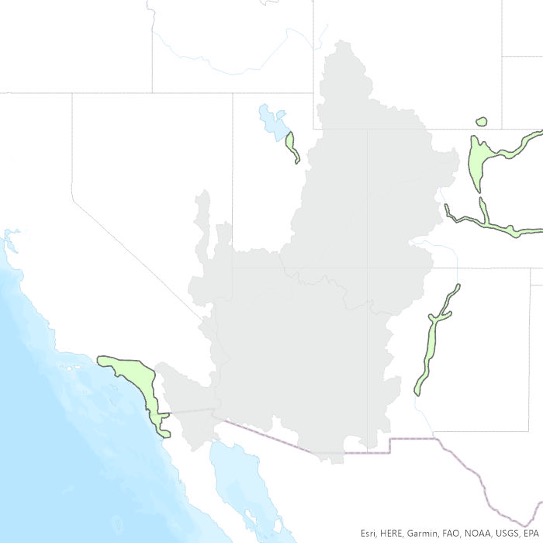
Short for adjacent areas served by Colorado River water. It refers to locales outside the hydrologic basin of the Colorado River, where its waters are exported via transbasin diversions. Most of the population that relies on Colorado River water lives in large cities in the Adjacent Areas Served, such as Denver, Los Angeles, and San Diego.
The Adjacent Areas Served, as defined in this report, generally correspond with the “adjacent areas that receive Colorado River water” as defined by the U.S. Bureau of Reclamation (2012), with two notable differences. One is the watershed of the Salton Sea, a portion of which is classified as an adjacent area by the Bureau of Reclamation because it receives Colorado River water via the All-American Canal and Colorado River Aqueduct but no longer contributes tributary flow to the river. However, before Hoover Dam was built, the Colorado River would sometimes migrate from its current channel and into the Salton Sink (see, e.g., Ross 2020). Because of that connection, we include it within the hydrologic CRB area, rather than in Adjacent Areas Served. See U.S. Bureau of Reclamation, 2012, p. ES-3.
The second exception is the area in northwestern Mexico encompassing the cities of Tijuana and Ensenada. Colorado River water is exported to Tijuana via the Colorado River-Tijuana aqueduct. For our purposes this counts as an AAS, but since it is a Mexican infrastructure project, it is not included in Bureau of Reclamation service area maps. The city of Ensenada is included in this area because Tijuana sends Colorado River water there via a pipeline that was originally constructed to pump water in the opposite direction. Although in our map this area may appear contiguous with the Southern California AAS that includes San Diego and Los Angeles, it is not part of the same service area on account of the international border.